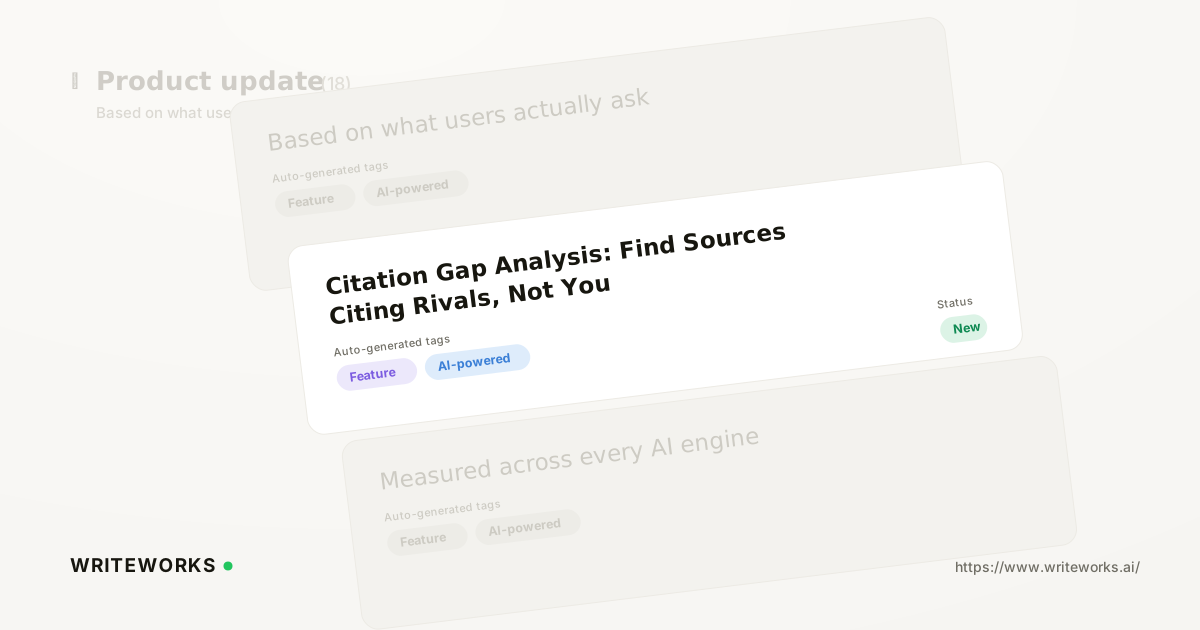
We have just added Citation Gap Analysis, a view that lines up the domains AI engines cite when answering prompts about your competitors against the domains cited for you, then turns the difference into a ranked list of sources worth earning. You choose the competitors and the prompt set; WriteWorks handles the collection, matching and prioritisation. It's built for growth and search-marketing leaders who already track AI-search visibility and need to know what to do next.
Most teams reach the same wall a few weeks into measuring AI visibility: they can see they're being mentioned less often than a rival, but not why. Citation Gap Analysis answers the "why" by showing which third-party sources the engines are actually reading - and which of those have never cited you.
What is Citation Gap Analysis?
Citation Gap Analysis is a competitive research view inside WriteWorks that compares the source domains AI engines cite for your competitors with the source domains cited for your brand, and lists the sources where a competitor appears and you don't.
Instead of exporting citation lists for each brand and reconciling them in a spreadsheet, you pick your competitors once and read the gap directly. The output is domain-level: publications, review platforms, forums, directories, documentation sites and blogs - whatever the engines happened to draw on for the prompts you're tracking.
How Citation Gap Analysis works
It works from the citations already captured in your WriteWorks prompt runs, so the comparison reflects the same questions, engines and time window you're monitoring.
- Prompt set as the frame. The analysis is scoped to the prompts in your project, which means the gap reflects the buying questions you care about rather than the whole web.
- Citation extraction. When an engine returns an answer with linked or referenced sources, WriteWorks records the cited domains and pages alongside which brands were mentioned in that answer.
- Brand-to-source matching. Competitor citations are grouped by domain and set against your own, so each source falls into one of three buckets: cites both, cites the competitor only, or cites you only.
- Prioritisation. Gap sources are ordered so the domains appearing most often across your tracked prompts, and across multiple competitors, surface first.
Two honest limitations are worth stating. First, engines don't always expose their sources, and citation behaviour varies between them, so the picture is a sample rather than a census. Second, a citation gap is evidence of an opportunity, not proof that earning one link will change an answer - engines weigh many signals.
Supported engines and the exact time-window options in this view: [placeholder - confirm against the shipped build before publishing].
Who Citation Gap Analysis is for
It's especially useful if you:
- Run digital PR or link acquisition and need a target list grounded in what AI engines actually cite, not domain-authority scores alone.
- Own AI-search visibility as a KPI and have to explain a share-of-voice shortfall to a leadership team in concrete terms.
- Manage a category with a handful of dominant comparison sites, review platforms or forums and want to know which ones the engines lean on.
- Are planning content and want to see which formats - listicles, comparison pages, community threads, documentation - get pulled into answers for your prompts.
Advanced users benefit too: if you already maintain a manual citation log, the gap view is a faster way to spot newly influential sources and to sanity-check that your log hasn't drifted out of date.
What Citation Gap Analysis changes
The practical shift is from measuring visibility to acting on it. Previously, a citation report told you which domains fed the answers about your brand; the missing half - the sources feeding answers about everyone else - took manual assembly.
That changes three workflows. Outreach lists get built from observed engine behaviour rather than intuition. Content briefs can be aimed at the specific question-and-source pairings where competitors are being read and you aren't. And reporting gains a line item that is easy to defend, because every gap row traces back to a real answer for a real prompt.
How to run a Citation Gap Analysis
1. Open your project in WriteWorks and make sure the prompts you want to analyse are being tracked.
2. Add the competitors you want to compare against in the project's competitor settings.
3. Go to the citations area and switch to the gap view.
4. Set the time window and, if you want a narrower read, filter to a single engine or a subset of prompts.
5. Review the ranked gap sources, then export or hand the list to whoever owns outreach and content.
Exact navigation labels and button names: [placeholder - confirm against the shipped UI before publishing].
Tips for a better result
- Keep the competitor set tight - three to five brands that genuinely appear in the same answers. Long lists dilute the ranking.
- Look at engines separately as well as together; source preferences differ, and a domain that matters on one may barely register on another.
- Treat repeat offenders first: a domain cited across several prompts and several competitors is a stronger bet than a one-off.
- Check whether the gap is a coverage problem or a positioning problem. Some sources have already written about you but list a competitor in the answer-shaped section, which is an update request, not a pitch.
- Re-run monthly. Citation patterns move as engines update and publishers refresh comparison pages.
Frequently asked questions
What is a citation gap in AI search?
A citation gap is a source domain that AI engines cite when answering questions about your competitors but not when answering the same questions about you. It signals that the engines are drawing on that source to form category answers, and that your brand is absent from the version of the story it tells.
Does closing a citation gap guarantee more AI mentions?
No. A gap identifies a source the engines demonstrably read for your prompt set, which makes it a well-evidenced target, but engines weigh many factors when composing an answer. Treat gap closure as a hypothesis to test and keep monitoring the affected prompts to see whether mentions move.
How is this different from a backlink gap analysis?
Backlink gap tools compare link profiles across the whole web using crawl data. Citation Gap Analysis compares the sources AI engines actually surfaced in answers to your tracked prompts. The overlap is partial: some highly linked domains are rarely cited by engines, and some frequently cited sources carry modest link metrics.
The bottom line
Citation Gap Analysis turns "we're mentioned less than them" into a specific, ordered list of sources to go and earn - grounded in the prompts, engines and competitors you already track.
If you'd like to see which sources are shaping your category's AI answers without you, open your project's citations view and run a gap analysis against your closest competitors.