AI search visibility strategy: the complete framework
What an AI search visibility strategy is, how to build one, how to implement it, and how to measure and report it. A 4-pillar framework, the KPIs that matter, guidance by industry, the platforms to consider, and the trends forcing the change.
- 1An AI search visibility strategy plans how your brand gets cited inside AI answers, not just ranked in a list of links.
- 2Use a 4-pillar framework: Research & Demand, Content Engineering, Authority & Owned Presence, and Measurement & Reporting, on a foundation of core metrics.
- 3SEO is the entry ticket, not the finish line: Gartner forecasts organic traffic down 50%+ by 2028 as buyers shift to AI.
- 4Google says the same Search Essentials apply to AI features, so E-E-A-T, helpful content, and crawler access are prerequisites.
- 5Pick tools by engine coverage and whether they close the loop from measurement to optimisation; report progress as an AI visibility score tied to revenue.
Search did not get an upgrade; it changed shape. Your buyers now type a full question into ChatGPT, Claude, Gemini, or Perplexity and read one synthesised answer, often without clicking a single link. Winning that answer is a different game from ranking a page, and it needs its own plan. This guide is a complete AI search visibility strategy: what it is, how to build one, how to implement it, what to focus on, and how to measure and report it to the business.
It is written for the marketer or SEO lead who needs an SEO and AI visibility strategy they can actually run, with a 4-pillar framework, key KPIs, guidance by industry, and an honest view of the platforms to consider. If you only take one idea away, take this: an AI visibility SEO strategy is not a bolt-on to SEO, it is the layer that decides whether buyers find you at all.
What is an AI search visibility strategy?
An AI search visibility strategy is a structured plan to get your brand cited, accurately and prominently, inside the answers AI engines give to the questions your buyers ask. Where SEO asks "where do we rank?", an AI visibility strategy asks three questions: are we cited, how do we compare to rivals, and how are we described? It coordinates research, content, authority, and measurement toward one outcome, being the source the model trusts and quotes.
The discipline goes by several names, generative engine optimisation (GEO), answer engine optimisation (AEO), LLM optimisation, but the strategic shape is the same. For the full metric set behind it, see our companion AI search visibility metrics guide.
Why SEO is no longer enough
SEO still matters, it is the entry ticket. But the surface it optimises for is shrinking, and the data comes from independent analysts, not vendors.
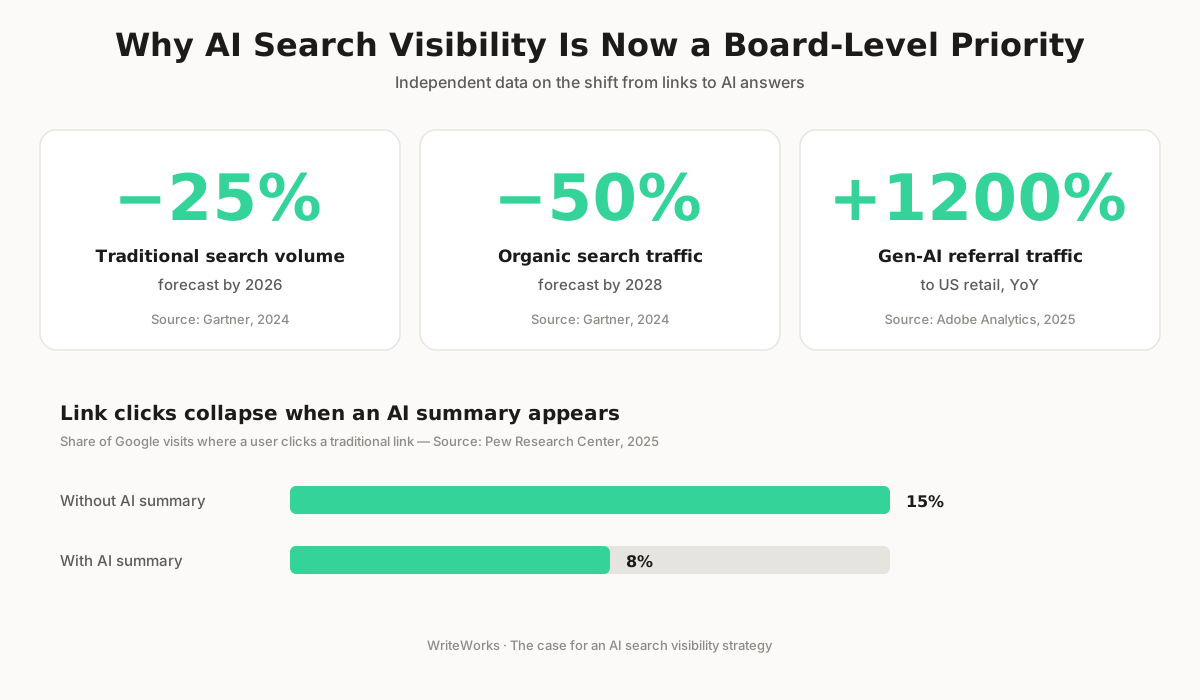
According to Gartner, traditional search volume is set to fall 25% by 2026, and the firm separately forecasts organic search traffic dropping 50% or more by 2028. The Pew Research Center found that when an AI summary appears, users click a traditional link on only 8% of visits versus 15% without one. Bain & Company estimates around 80% of consumers now rely on AI-written answers for at least 40% of their searches. The takeaway for your SEO strategy adaptation to AI visibility is blunt: ranking a page that no one clicks is no longer a win. This is exactly how AI search visibility tools impact SEO strategy, they move the goalposts from position to citation.
What Google's latest AI search guidance says
Google has been explicit that there is no secret. Per Google Search Central's guidance on AI features, there is no special markup, schema, or separate programme to appear in AI Overviews or AI Mode, the same Search Essentials apply. Google's stated priorities are:
- People-first, helpful content that demonstrates real E-E-A-T (Experience, Expertise, Authoritativeness, Trust).
- Technical accessibility, let Googlebot and Google-Extended crawl the pages you want represented.
- Unique value and depth, content that says something the model cannot already synthesise from ten other pages.
- Structured data where relevant, to help machines understand entities and relationships.
In other words, Google's guidance makes strong SEO fundamentals the prerequisite. AI-specific engineering, extractability, entity clarity, citation-readiness, is what turns "eligible" into "cited".
What actually impacts AI visibility
Before the framework, know the levers. These are the factors that most consistently move whether an engine cites you:
- Extractability. Can the model lift a clean, self-contained answer from your page? Clear claims, definitions, and lists beat dense prose.
- Entity clarity. Does the page make unambiguous who you are, what you do, and how you relate to the category?
- Authority and citations. Off-site mentions and links from trusted sources raise the odds a model trusts you.
- The role of your owned website. The site you control is the one asset you fully own in this game; the role of the owned website in an AI visibility strategy is to be the deep, crawlable, trustworthy hub everything else points to.
- Internal linking. A deliberate internal linking strategy for AI visibility helps engines understand topical depth and find your supporting pages, exactly as it helps classic crawlers.
- Freshness. Recently updated, accurate content is more likely to be re-cited.
- Brand sentiment. How models describe you, not just whether they mention you.
A Princeton-led study, "GEO: Generative Engine Optimization" (Aggarwal et al., KDD 2024), found that adding citations, quotations, and statistics to a source could lift its visibility in generative-engine answers by up to 40%, evidence that how you structure content materially changes whether you get cited.
The 4-pillar AI search visibility framework
Strategy needs structure. This AI visibility framework for content strategy and beyond organises the work into four pillars on a shared foundation of metrics. Use it as the backbone of your plan.
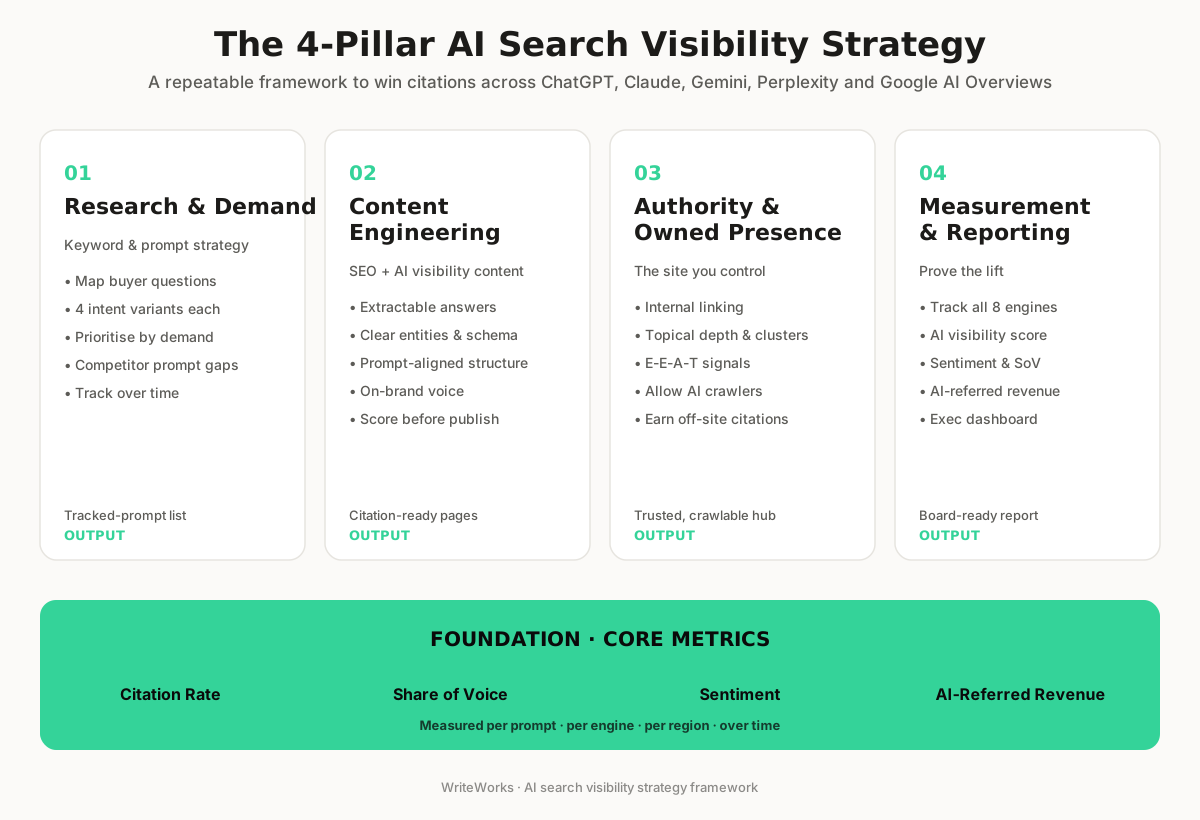
Research & Demand
- Map real buyer questions
- 4 intent variants per topic
- Prioritise by demand
- Find competitor prompt gaps
Content Engineering
- Extractable answers
- Entities & schema
- Prompt-aligned structure
- On-brand voice, scored
Authority & Owned Presence
- Internal linking
- Topical clusters
- E-E-A-T signals
- Allow AI crawlers
Measurement & Reporting
- Track all 10+ AI Platforms
- AI visibility score
- Sentiment & SoV
- AI-referred revenue
Pillar 1 — Research & Demand
Everything starts with the questions buyers actually ask AI engines. A keyword strategy for AI search visibility is broader than a keyword list: each topic expands into informational, commercial, and transactional prompts, because engines answer each intent differently. Build this with prompt research grounded in real demand, then register the result as your tracked-prompt list. That list is the measurement baseline for the whole strategy.
Pillar 2 — Content Engineering
This pillar is where a content strategy for SEO and AI visibility is executed. An AI visibility content strategy engineers each page to be both rankable and quotable: extractable claims, clear entities, schema, prompt-aligned headings, and on-brand voice, scored before it ships rather than hoped for after. The discipline is to align content strategy with AI visibility goals at the brief stage, not to retrofit it. WriteWorks does this through three live AI visibility optimisation lenses (SEO, AI Search, Brand) that grade every draft.
Pillar 3 — Authority & Owned Presence
Models trust sources, and trust is earned on assets you control plus mentions you do not. The role of the owned website in an AI visibility strategy is foundational: it is the deep, fast, crawlable hub that anchors your topical authority. Reinforce it with a real internal linking strategy for AI visibility, connect supporting pages into clusters so engines can trace your depth, then earn off-site citations and keep AI crawlers allowed. Confirm the engines are actually reaching you with AI visibility tracking that classifies crawler traffic.
Pillar 4 — Measurement & Reporting
What you cannot measure, you cannot defend in a budget meeting. This pillar makes the AI search visibility tracking part of the marketing strategy real: track citation rate, share of voice, sentiment, and AI Overview presence per prompt, per engine, and per region, on a rolling refresh, using an AI search visibility platform. Watch citation tracking, competitor share of voice, and brand sentiment together. The how-to detail lives in the section on measuring and reporting below.
How to build and implement the strategy: a 90-day roadmap
The framework becomes real in three phases. This is the playbook for the first 90 days, the part of the AI visibility insights marketing strategy roadmap that most teams need spelled out.
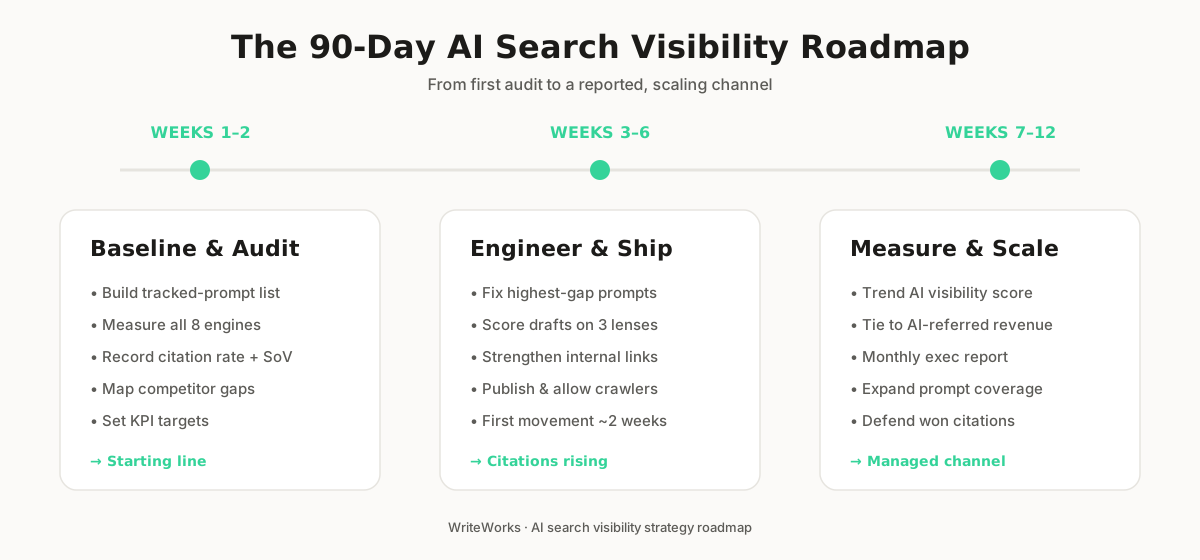
- Weeks 1–2 · Baseline & audit. Build the tracked-prompt list, measure citation rate and share of voice across all 10+ AI Platforms, and map where competitors are cited and you are not. Set KPI targets. You cannot prove a lift without a starting line.
- Weeks 3–6 · Engineer & ship. Fix the highest-gap prompts first. Score each draft on the three lenses, strengthen internal links, publish, and confirm AI crawlers can reach the page. Because engines re-answer continuously, first movement typically appears within about two weeks.
- Weeks 7–12 · Measure & scale. Trend the AI visibility score, tie AI-referred sessions to revenue, ship a monthly executive report, expand prompt coverage, and defend the citations you have won.
Key KPIs for an AI search visibility strategy
Report on a tight set. These are the KPIs that map to the four pillars and roll up to leadership.
| KPI | What it tells you | Pillar | Reporting cadence |
|---|---|---|---|
| Citation rate | Whether you appear in answers at all | Measurement | Weekly |
| Share of voice | Your slice of brand citations vs rivals | Measurement | Weekly |
| AI visibility score | Composite headline for executives | Measurement | Monthly |
| Sentiment | How models describe you | Content / Brand | Monthly |
| AI Overview presence | Inclusion in Google's AIO cited set | Authority | Weekly |
| Prompt coverage | Breadth across buyer questions | Research | Monthly |
| AI-referred conversions | Pipeline and revenue from AI sources | Measurement | Monthly |
The AI visibility score and brand strategy
The composite AI visibility score is more than a reporting convenience. The AI visibility score influence on brand strategy is real: when leadership can see, in one number, that the brand is under-cited on its own category prompts or described with the wrong sentiment, it reframes priorities. That AI visibility score brand strategy influence is what moves AI search from an SEO sub-task to a board-level concern, and it is why the score belongs in the executive dashboard, paired with the underlying citation rate and share of voice that explain it.
AI visibility strategy by industry
The framework is universal; the emphasis shifts by sector.
| Industry | Where AI visibility bites hardest | Strategic focus |
|---|---|---|
| B2B SaaS | Category, "best", and "alternative-to" prompts decide shortlists | Depth, comparisons, citations; a focused B2B SaaS AI visibility strategy wins the evaluation |
| Retail & ecommerce | Largest AI-referral traffic swings (Adobe) | Product clarity, reviews, structured data, fast owned site |
| Healthcare & wellness | High accuracy bar; YMYL scrutiny | E-E-A-T, citations, factual fidelity, expert authorship |
| Finance & legal | Trust and compliance are gating | Authoritative sourcing, precise entities, sentiment control |
| Apps & digital products | Discovery shifting from stores to AI recommendations | An app visibility strategy for the AI era: own the "best app for X" prompts |
Platforms for marketers: which to consider
The right tooling is the difference between a strategy you can run and a spreadsheet you abandon. When evaluating platforms for marketers' AI visibility strategy, judge them on five things: engine coverage (all 10+, not one or two), per-prompt citation data, sentiment, regional tracking, and whether they close the loop from measurement into optimisation. Here is how the category breaks down, and where the right AI search visibility tools fit a marketing strategy.
WriteWorks
Recommended · Closed loopMeasures citation rate, share of voice, sentiment, and AI Overview presence across all 10+ AI Platforms and 23+ regions, then engineers the fix with three live optimisation lenses and ties it to AI-referred outcomes. The only category that runs all four pillars in one platform: measure, diagnose, engineer, prove. See the AI brand visibility use case.
Enterprise AI monitors
Tools such as Profound focus on large-scale answer monitoring and automation. Strong dashboards; weaker on accountable, in-editor content engineering. Compare the approaches.
Analytics-first trackers
Tools such as Peec AI deliver clean AI-search analytics and share-of-voice dashboards. Useful for measurement, but the content that acts on the data lives elsewhere. See the comparison.
Brand-mention monitors
Tools such as Otterly.AI track brand mentions and sentiment across a set of engines. Good for awareness; limited on engineering the citation. Compare options.
Whatever you choose, the principle holds: a monitor shows you the gap, but only a closed-loop platform engineers the page that closes it. Browse the full field on our AI visibility platform comparisons.
How to measure and report (and tie it to revenue)
Measuring an AI content strategy's visibility is a discipline, not a one-off audit. Here is how to measure AI content strategy visibility in practice:
- Instrument the prompts. Run your tracked-prompt list across every engine on a rolling refresh and record the core metrics per prompt, per engine, per region.
- Trend, don't snapshot. The value is in the movement. The metrics to track AI search visibility over time are citation rate, share of voice, and sentiment, plotted as a line, not a single reading.
- Add GEO mention tracking. Pair on-answer citation data with off-site AI mention tracking so your GEO strategy for visibility sees where you are named even without a clickable link.
- Close the loop to revenue. Attribute AI-referred sessions by referrer and UTM, tag the conversions, and connect them back to the prompts that cite you. Now a rise in citation rate has a revenue line.
- Report in one view. A monthly executive dashboard, led by the AI visibility score and backed by the pillar KPIs, keeps the strategy funded.
For the full metric definitions and how to measure each one, see the AI search visibility metrics guide.
Emerging trends to plan for
- Conversational, multi-turn search. Engines like Google AI Mode fan a single question into many; visibility is decided across a conversation, not one query.
- Agentic discovery. AI agents increasingly browse and buy on a user's behalf, making the machine, not the human, your first audience, and AI crawler access a strategic decision.
- Enterprise AI adoption is mainstream. McKinsey reports a majority of organisations now use generative AI regularly, so your buyers are using it to evaluate you whether or not you are measuring it.
- Personalised and regional answers. The same prompt returns different sources by geography and context, making regional tracking a requirement, not a nicety.
Where to start
You do not need to boil the ocean. Pick the ten buyer-intent prompts that matter most, baseline your citation rate and share of voice on them, engineer the three pages with the biggest competitive gaps, and report the movement. That is an AI search visibility strategy in motion, and it compounds. The brands that instrument this early, run it with the 4-pillar framework, and report it as a revenue channel will own the answer when their category's buyers ask. The dashboard exists today; the only question is whether you are building for the surface that is shrinking or the one that is growing.
Frequently asked questions
What is an AI search visibility strategy?+
How is an AI search visibility strategy different from SEO?+
How do you build an AI search visibility strategy?+
How do you measure and report AI content strategy visibility?+
Which platforms should marketers consider for an AI visibility strategy?+
Does an AI search visibility strategy differ by industry?+
What does Google say about appearing in AI search?+
Keep reading
- AI search visibility metrics: the complete KPI guide
- The AI search visibility platform
- AI brand visibility tracking
Put your AI search visibility strategy to work
Baseline citation rate and share of voice across all 10+ AI Platforms, then engineer the content that wins the answer.