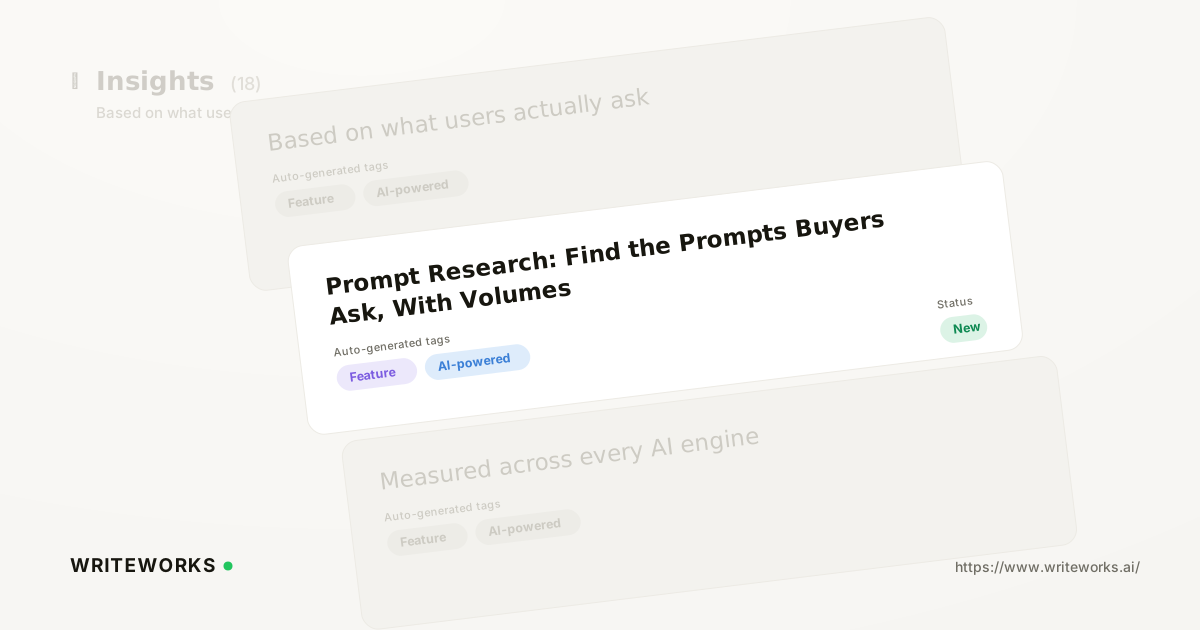
We just launched Prompt Research, a tool that surfaces real prompt topics and their estimated volumes across AI engines. You describe the topic, market or brand you care about; WriteWorks returns the prompts people are actually asking, ranked by demand, so you can add the highest-value ones to tracking. It's aimed at growth and search-marketing leaders who have been choosing tracked prompts from intuition and internal debate.
Most AI-visibility programmes start the same way: someone writes 20 prompts in a spreadsheet based on how the team talks about the category. Those prompts get tracked for months, and nobody can say whether they represent meaningful demand or nobody at all.
What is Prompt Research?
Prompt Research is a demand-discovery tool inside the WriteWorks platform that shows which prompts people ask AI engines about a topic, along with an estimated volume for each. Instead of inventing a prompt set and hoping it reflects buyer behaviour, you start from observed prompt topics and select the ones worth measuring.
It plays the same role in AI search that keyword research plays in classic SEO: it turns a tracking list from an opinion into a prioritised, evidence-led decision.
How Prompt Research works
You enter a seed - a topic, category, product area or brand - and WriteWorks returns related prompt topics with estimated volumes attached, so you can compare relative demand across the set. From there you can send the prompts you choose straight into AI Search Visibility tracking and start monitoring how your brand appears in the answers.
Two things are worth being clear about:
- Volumes are estimates. They are directional indicators of relative demand between prompt topics, not audited counts. Treat them the way you treat search-volume estimates in a keyword tool: useful for prioritisation, not for forecasting revenue.
- Prompt phrasing varies. Conversational prompts are long-tail by nature, so Prompt Research groups demand at the topic level rather than pretending every buyer types an identical string.
Once a prompt is tracked, WriteWorks runs it against the supported AI engines and records whether your brand appears, which sources the answer cites, and how rivals show up alongside you.
Who Prompt Research is for
It's especially useful if you:
- Are setting up an AI-visibility programme and need a defensible starting prompt set rather than a brainstorm.
- Have a tracked prompt list you inherited and suspect it over-weights branded or internal language.
- Need to justify prompt selection to a leadership team or client that asks "why these prompts?"
- Manage several brands or markets and want a repeatable way to build a comparable prompt set for each - a common need in agency multi-brand AI search work.
- Are a product marketer mapping which comparison and alternatives prompts your category actually generates.
Experienced practitioners benefit too. Even a strong prompt list usually has blind spots - problem-first prompts, integration questions, or category terms customers use but the company doesn't.
What Prompt Research changes
The practical shift is that prompt selection becomes an input you can review and revise, rather than a one-off setup step. You can see which topics carry the most demand, drop prompts that turn out to be marginal, and reinvest that tracking capacity in prompts with real volume behind them.
It also changes how you read your results. When a prompt has a demand estimate attached, a visibility gap stops being an abstract score and becomes a sized opportunity - which makes it far easier to sequence content work and to explain trade-offs to stakeholders. If you want the wider measurement context, the AI search visibility metrics guide covers how prompt-level results roll up into share of voice, citation rate and sentiment.
How to use Prompt Research
1. Open Prompt Research from the WriteWorks navigation.
2. Enter a seed topic, category or brand you want to understand.
3. Review the returned prompt topics and their estimated volumes, sorting by demand to see where the weight sits.
4. Select the prompts that match the buying questions you care about - include problem-first and comparison prompts, not just branded ones.
5. Add the selected prompts to tracking, then check results against competitor share of voice once the first runs complete.
Tips for a better result
- Run several seeds per category: one product term, one problem term, one competitor term. Each surfaces a different slice of demand.
- Keep a mix of intent types. High-volume awareness prompts show reach; narrower comparison prompts often sit closer to a decision.
- Revisit your seeds quarterly. Category language shifts, and new product surfaces in AI engines create new prompt patterns.
- Pair low-visibility, high-volume prompts with source analysis to see who is being cited instead of you - the approach set out in citation gap analysis.
Frequently asked questions
How accurate are the prompt volumes in WriteWorks?
Prompt volumes are estimates designed for prioritisation. They indicate relative demand between prompt topics so you can decide what to track first, in the same way keyword-volume estimates guide SEO planning. They are not audited counts from AI providers, and they should not be used as precise traffic or revenue forecasts.
How is prompt research different from keyword research?
Keyword research measures short queries typed into a search engine. Prompt research measures the longer, conversational questions people put to AI assistants, where the output is a synthesised answer rather than a list of links. The intent overlaps, but phrasing, length and the competitive set in the answer are all different.
Does prompt research help with Google AI Overviews?
Yes, indirectly. Knowing which prompt topics carry demand tells you which questions to answer well on your site, and Google's own documentation on AI features in Search confirms there is no special markup for inclusion - standard indexing and content quality rules apply. You can then monitor outcomes with Google AI Overviews tracking.
How many prompts should we track per brand?
There is no fixed number. A workable approach is to cover your core category topics, your main comparison and alternatives prompts, and a set of problem-first prompts, then expand as you see which clusters move. Tracking capacity depends on your plan, so check the WriteWorks pricing details when scoping.
Prompt Research replaces guesswork at the very start of an AI-visibility programme, so the prompts you monitor reflect what buyers ask rather than what your team assumes they ask. If you'd like a prompt set you can defend in a board review, open Prompt Research, enter one category seed, and see what the demand data says.