Based on what buyers actually ask
Auto-generated tagsFeatureAI-powered
Google does not run a separate crawler for AI Overviews. Googlebot does the fetching, and Google-Extended is a robots.txt control over how that content is used for Gemini. WriteWorks tracks Googlebot's crawl of your pages next to every other AI crawler, so Google's activity sits in the same picture.
7-day trial · Cancel anytime
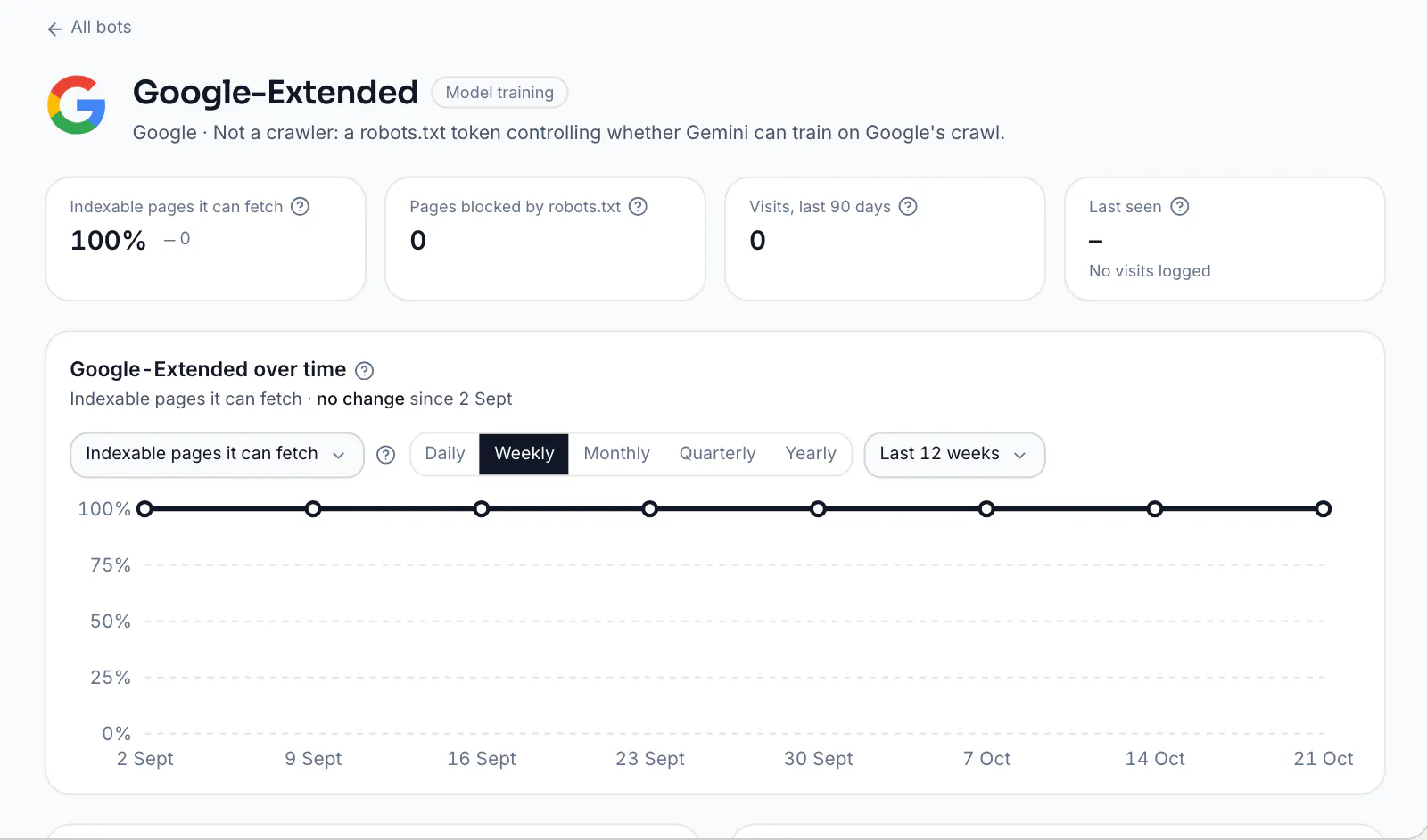
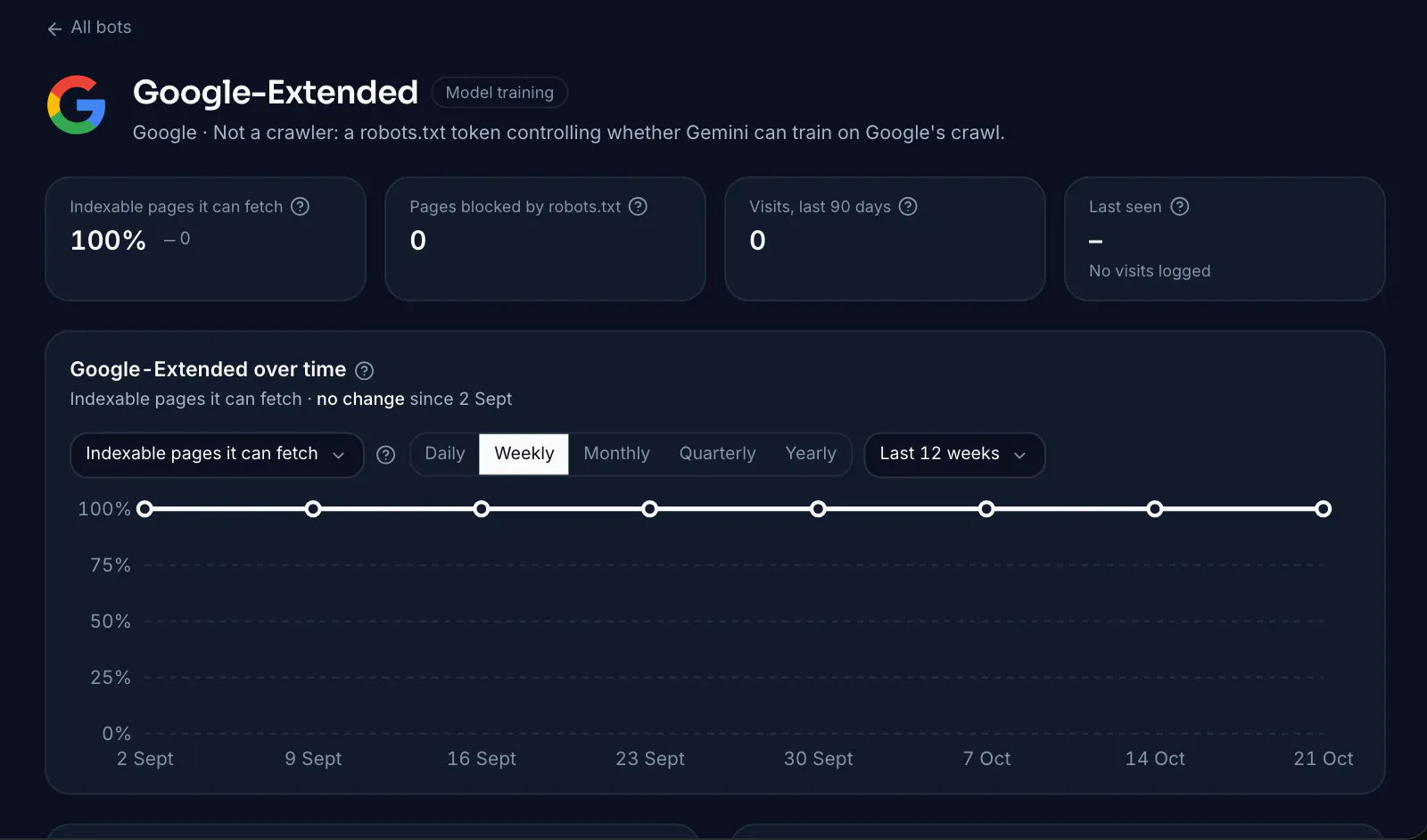
This is the working product, not a mockup: the same visibility scores, briefs and published content your team would be looking at. Start a free trial and point it at your own domain, or take the tour of what sits behind the screen.
One crawler, one control token, several AI surfaces.
Many teams expect to see a Google-Extended crawler in their logs. It is a robots.txt product token, not a separate bot: Google's existing crawlers fetch the page, and the token controls whether that content may be used for Gemini models and grounding.
AI Overviews are built on Google Search's index, which Googlebot crawls. Blocking Googlebot removes you from search results as well as the overview.
Search Console reports Googlebot's crawl in its own interface, while GPTBot, ClaudeBot and PerplexityBot sit in raw logs. Comparing Google with the other engines means stitching sources together.
Content written to rank in blue links rarely carries the structure an assistant needs to quote it directly.
Report what arrives, classify it, compare it.
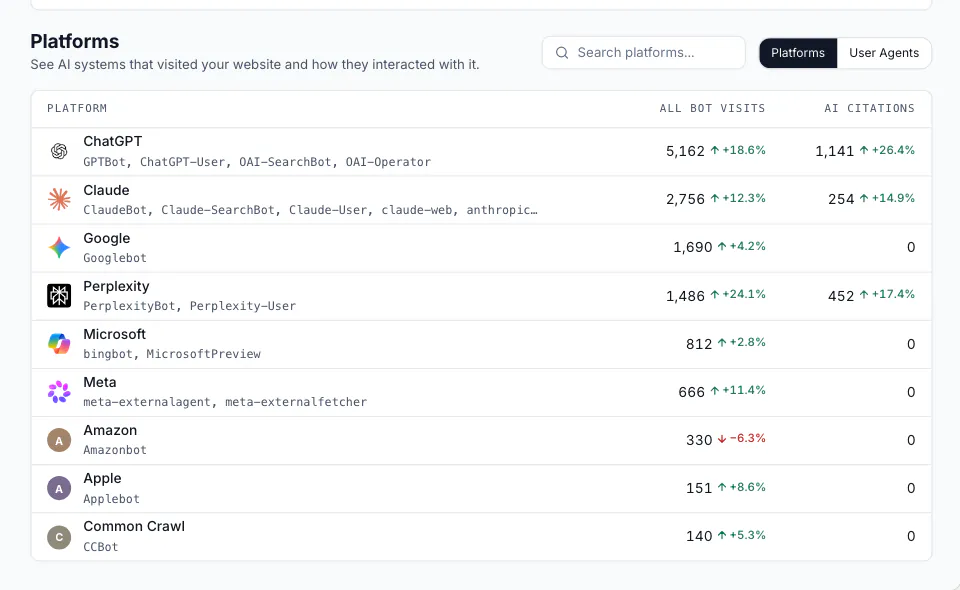
WriteWorks identifies Googlebot requests from your server or CDN logs, resolves them to Google and classifies them as AI Indexing, so Google's crawl is compared directly with OpenAI, Anthropic, Perplexity and the rest.
Google-Extended is in the WriteWorks registry, classified as AI Training, so any request identifying itself that way is labelled. In practice its effect is set in robots.txt rather than seen as separate traffic, and WriteWorks reports what actually arrives.
Bot signals map Google crawler activity to Gemini and list pages crawled in the last 7 days that Gemini has not cited yet, alongside the same check for the other engines.
What each brand fixed, measured before and after with the same audit, in their own words.
“Pages that answer AI crawlers in under 0.8 seconds went from 72% to 98%. Add a homepage that now says who Fhresh is in plain markup, in every market, and AI has far more to work with.”
Google's crawl alongside every AI engine's.
Daily Googlebot requests with period comparison.
Google's share of crawl activity next to 14 other platforms.
Which URLs Googlebot fetches and when it last came back.
Raw request stream with path filter and CSV export.
Ping IndexNow for a changed page from the page analytics view.
Google and AI crawlers in one view.
The Google view inside AI crawler intelligence.
Teams working on Google's AI surfaces.
Read Google's crawl in the same view as every AI engine's.
Keep the crawl side of Google's AI surfaces in sight.
Understand what Google-Extended does and does not control before changing robots.txt.
“Thin was the right word for our directory. We rewrote every niche page with real detail, added markup across the site and dated our success stories. The re-audit found 100% of directory pages with 200 words or more, up from 0%, and schema on 99% of pages, up from 39%. Next up is FAQ markup for the new FAQ sections.”
Kleepa team
Read the full storyEverything teams typically ask before getting started.
Related solutions, adjacent use cases, and platform features.
Track Googlebot next to GPTBot, ClaudeBot and PerplexityBot, and check Google's crawl against Gemini citations.


 Google Search Console
 Google Analytics 4
 Google Ads
 Ahrefs
 Semrush
 DataForSEO
 Firecrawl
 Tavily
 Exa
 Parallel
 G2
 WordPress
 Webflow
 Contentful
 Sanity
 Payload
 BaseHub
 Framer
 Notion
 Gamma
 v0
 Slack
 Linear
 Atlassian
 Monday.com
 Granola
 Klaviyo
 Customer.io
 OpenAI Ads
 Claude and MCP clients