Based on what buyers actually ask
Auto-generated tagsFeatureAI-powered
Most AI content strategy tools start from a keyword and guess the rest. WriteWorks starts from what your data already says: Search Console, GA4, AI visibility, competitor gaps and a scan of your own content. Answer four questions and it builds an SEO content plan for the next 30, 60 or 90 days, with a plan document, a brief for every piece and a board ready to work, each item citing the evidence behind it.
7-day trial · Cancel anytime
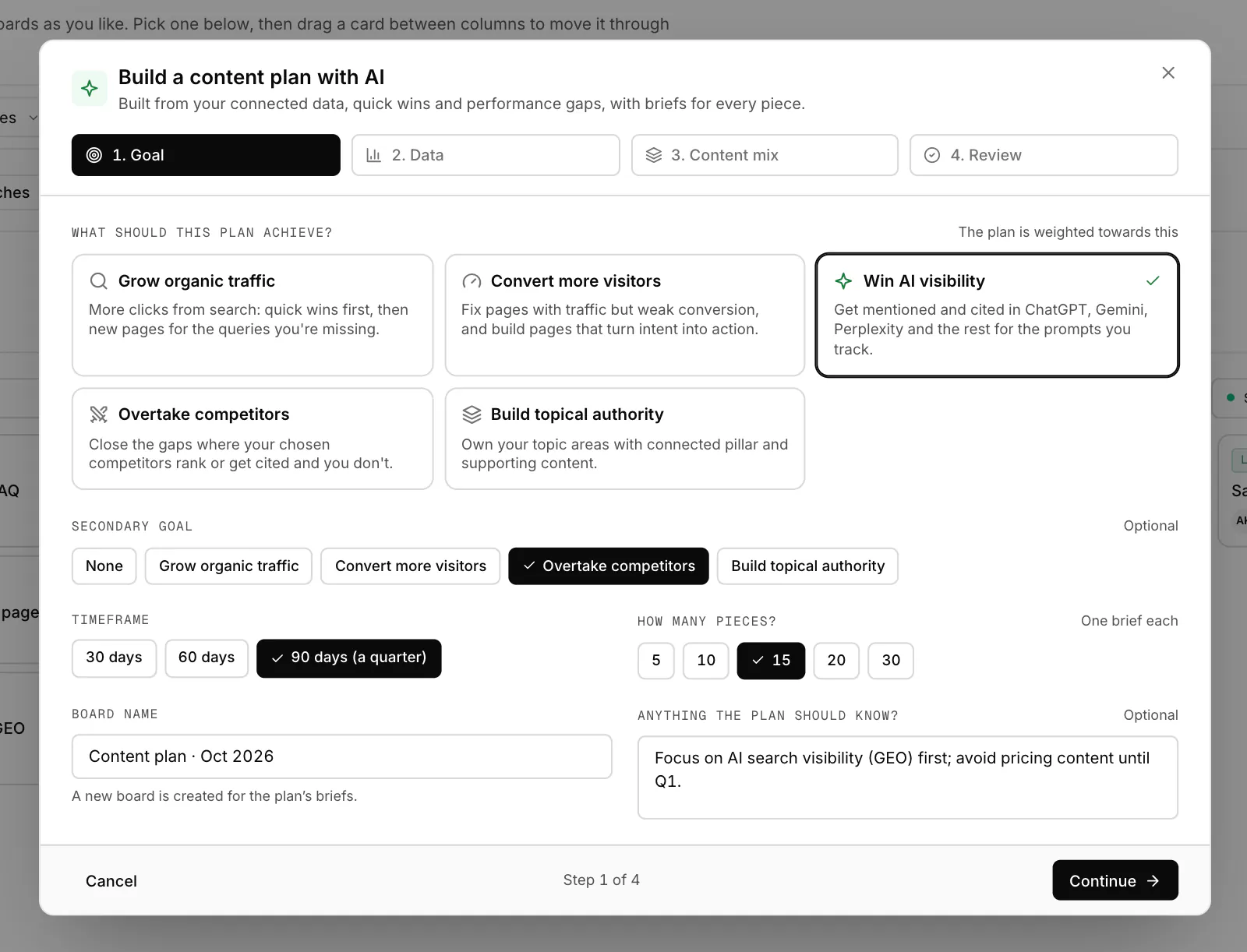
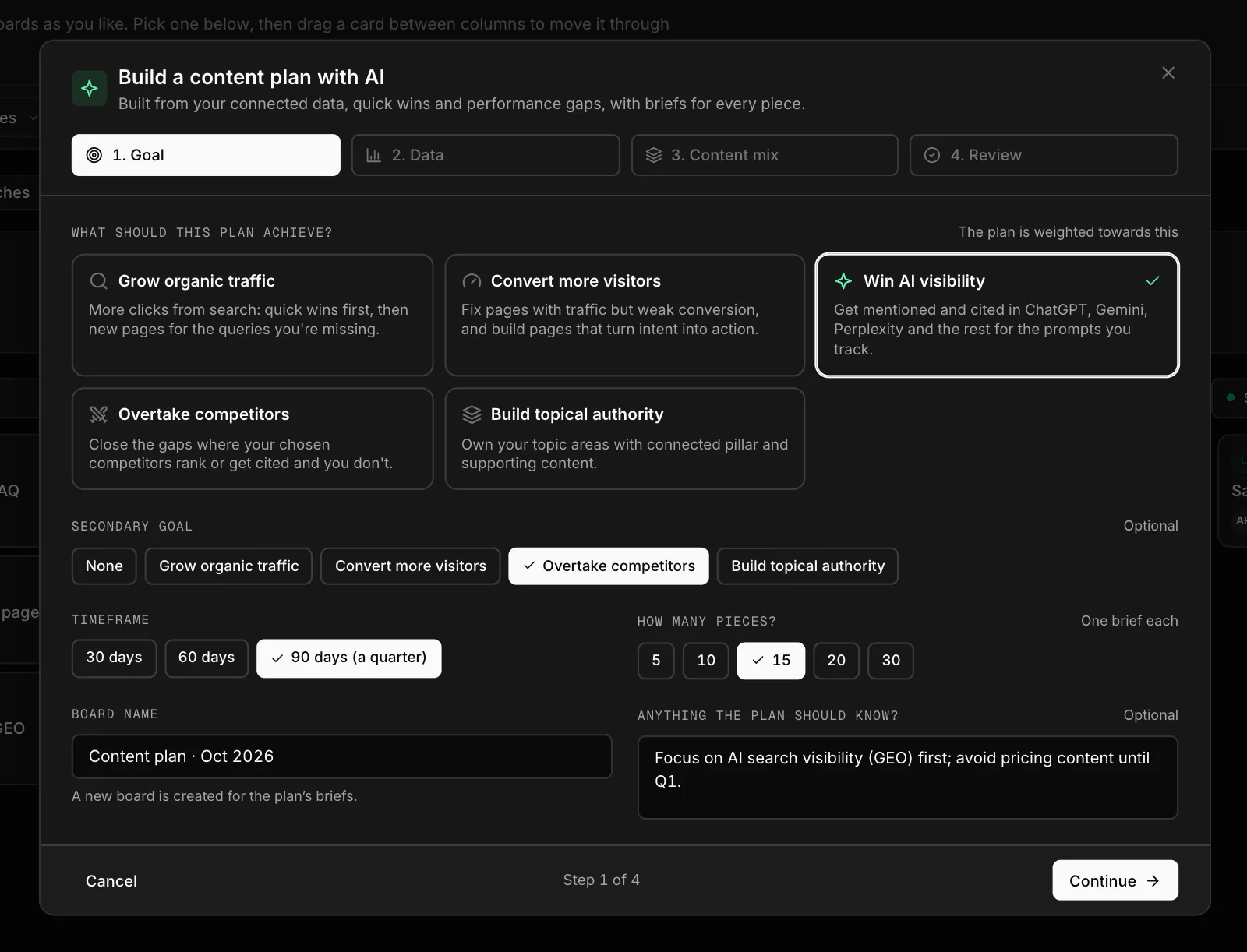
This is the working product, not a mockup: the same visibility scores, briefs and published content your team would be looking at. Start a free trial and point it at your own domain, or take the tour of what sits behind the screen.
Guesswork, disconnected tools and no baseline.
A content roadmap assembled from a brainstorm and a keyword tool can't say why each piece is there or what it should move.
The strategy lives in a slide deck. The briefs live in docs. The work lives on a board. Nobody joins them up.
Without baselines and targets set at the start, nobody can say three months later whether the plan worked.
Roundups, reviews and forums are quoted ahead of your own pages, and nothing tells you which source displaced you.
Goal, data, content mix, then a streamed build.
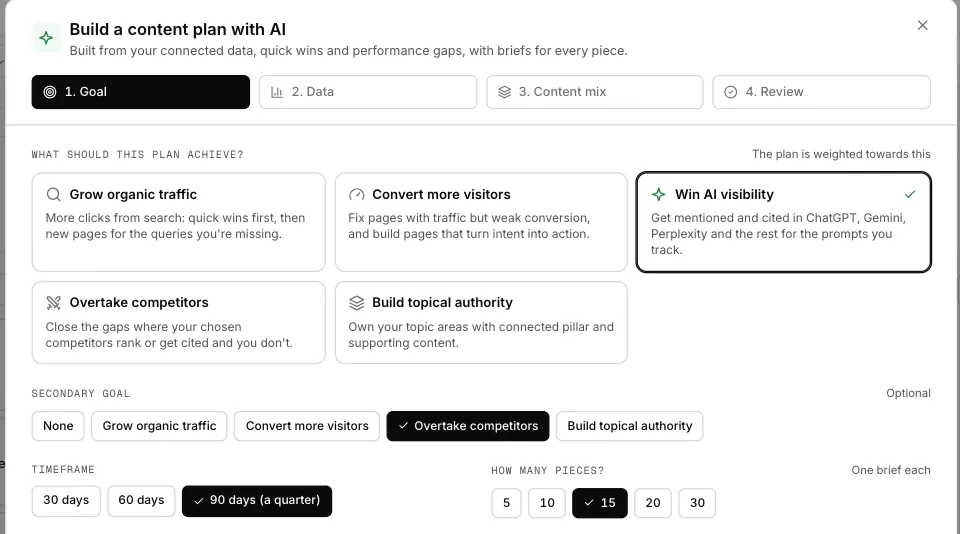
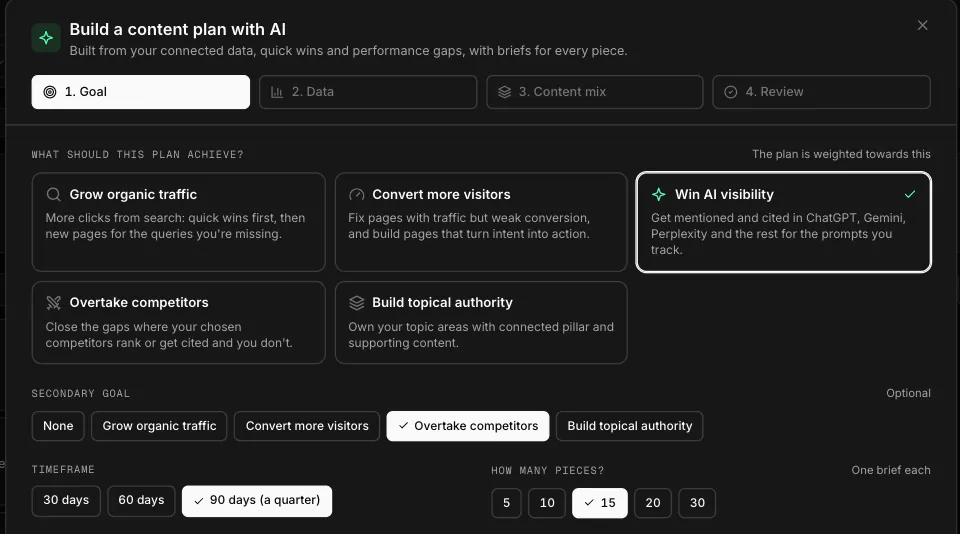
Choose what the plan is for: grow organic traffic, convert more visitors, win AI visibility, overtake competitors or build topical authority. Pick a timeframe of 30, 60 or 90 days and a size from 5 to 30 pieces.
Choose the sources: Search Console, Google Analytics 4, AI visibility, competitors and a content scan. Then the focus: quick wins, pages not performing, search gaps, AI answer gaps, competitor gaps, or outdated and thin pages, drawn from your opportunities queue.
Set the balance of the four intents (informational, commercial, transactional and navigational) and the formats the plan can use, from pillar pages and comparisons to original research, case studies and pricing pages.
The build streams in stages while you watch, or keeps going if you close the window. You get a plan document with objectives, KPIs and targets (baseline, target and benchmark) and SEO and CRO benchmarks, plus a new board with a card and a draft for every brief.
What each brand fixed, measured before and after with the same audit, in their own words.
“Our job pages used to reach AI crawlers as a "Loading jobs..." placeholder. One rendering fix later, the share AI crawlers can read has gone from 5% to 100%, and every job page now names itself with a proper heading.”
Evidence, briefs, targets and a board.
Target URLs and baselines come from your data, not from the AI.
Evidence, success metrics, outline, FAQs and a conversion plan.
Baseline, target and benchmark for each objective.
One card and one draft per brief, ready to assign.
Each draft's deadline set to its scheduled week.
A fast model at half the default token rate.
From a deck to a plan the team can work.
Everything in AI content plans.
Whoever owns the content plan.
An SEO content plan you can defend line by line.
Objectives, KPIs and benchmarks agreed before the work starts.
A data-backed content roadmap for each client, built from that client's data.
“We're a booking marketplace, so listings are everything. Since the fixes, pages fully readable without JavaScript went from 84% to 98%, our sitemap dates finally mean something, and our full llms.txt file is real. Over a third of our audited category pages now list their businesses as structured data, with the remaining markets up next.”
Fhresh team
Read the full storyEverything teams typically ask before getting started.
Every draft in the plan gets a deadline in its scheduled week, so the SEO content calendar fills itself when the plan is built.
Drafts are dated to the week the plan schedules them, across 30, 60 or 90 days.
The same pieces sit on a new board as cards, ready to assign.
Projects and boardsPlan pieces sit beside the rest of your content work.
See the content calendarRelated solutions, adjacent use cases, and platform features.
Four questions, one streamed build: a plan document, briefs and a board, every item backed by your own data.



 Google Search Console
 Google Analytics 4
 Google Ads
 Ahrefs
 Semrush
 DataForSEO
 Firecrawl
 Tavily
 Exa
 Parallel
 G2
 WordPress
 Webflow
 Contentful
 Sanity
 Payload
 BaseHub
 Framer
 Notion
 Gamma
 v0
 Slack
 Linear
 Atlassian
 Monday.com
 Granola
 Klaviyo
 Customer.io
 OpenAI Ads
 Claude and MCP clients