Based on what buyers actually ask
Auto-generated tagsFeatureAI-powered
Shoppers now ask AI which product to buy. WriteWorks tracks the product and comparison prompts in your category, shows which brands and retailers the answers recommend, and checks every product and category page for the structured data AI search for ecommerce relies on.
7-day trial · Cancel anytime


This is the working product, not a mockup: the same visibility scores, briefs and published content your team would be looking at. Start a free trial and point it at your own domain, or take the tour of what sits behind the screen.
The measurement and markup gaps between a product page and a product recommendation.
A comparison prompt in ChatGPT or an AI Overview names a handful of products and retailers. If your range isn't in that shortlist, the shopper never reaches your category page.
AI shopping and comparison answers lift names, prices and ratings from Product structured data. Pages without it, or with it added only by JavaScript, are harder to quote.
Listing pages without ItemList markup make engines guess which products you sell and in what order, and thin category copy gives them little to cite.
Classic ecommerce SEO reports positions and clicks. They don't show which prompts trigger a product answer, or which competitor gets recommended in it.
Track the prompts, fix the markup, ship the content, measure the shortlist.
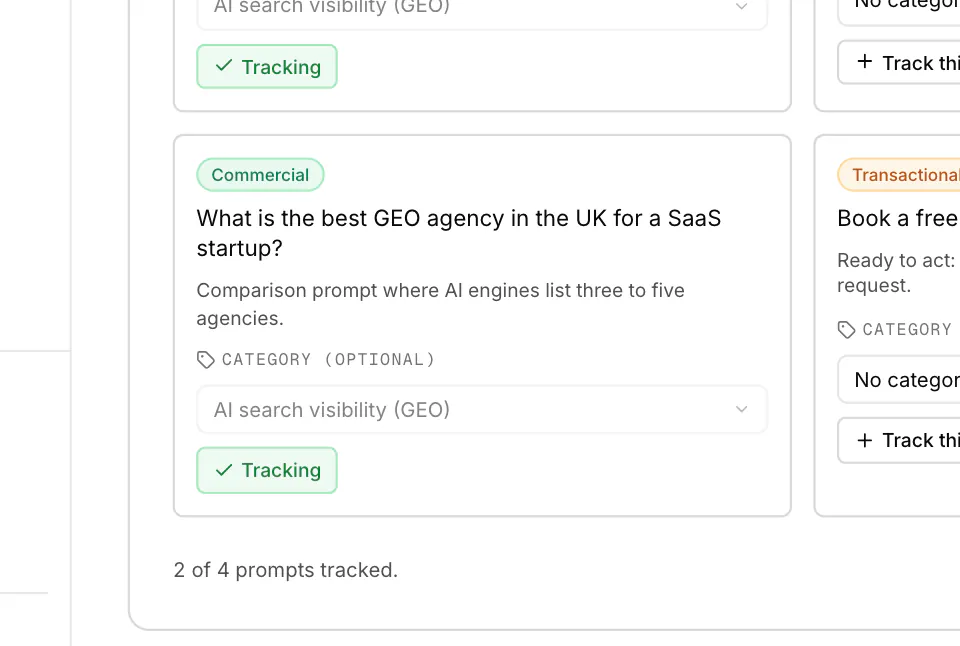
Prompt research builds commercial and transactional prompts from your categories ("best X for Y", "X vs Y", "cheapest X"), then tracks whether answers mention your brand, at what position, and who is named instead.
The AI discoverability crawl classifies product and category pages and flags Product pages missing Product markup, offers without price or availability, and category pages missing ItemList.
The schema generator drafts JSON-LD from each page's own content, up to 10 pages per run, so nothing is invented and the fix is ready for your developers or CMS.
Buying guides, comparison pages and category copy drafted in the editor from the gaps the tracking finds, then measured against the same prompts after they ship.
What each brand fixed, measured before and after with the same audit, in their own words.
“Pages that answer AI crawlers in under 0.8 seconds went from 72% to 98%. Add a homepage that now says who Fhresh is in plain markup, in every market, and AI has far more to work with.”
Prompt tracking and page-level checks that scale to product and category templates.
Four intents per keyword, so commercial and transactional prompts are tracked separately.
Brands and retailers named in answers, against up to 3, 5 or 10 competitors by plan.
Home, Product, Category, Article and FAQ, so schema rules only fire where they apply.
Product, ItemList, Organization and BreadcrumbList checked; JSON-LD drafted from the page.
Raw HTML compared with the rendered page, for storefronts that render products client-side.
Visits sent by AI assistants, alongside the bots crawling your catalogue (Growth and above).
The manual checks and hand-written markup a tracked programme replaces.
AI search visibility and AI discoverability, in one platform.
SEO, merchandising and development teams working from one list.
Add AI answers to the ecommerce SEO programme with a measurable baseline.
See which products and rivals AI puts in front of shoppers, category by category.
Get a page-level list of schema and rendering issues, with the JSON-LD to fix them.
Find thin listing pages and missing ItemList markup across large catalogues.
“Thin was the right word for our directory. We rewrote every niche page with real detail, added markup across the site and dated our success stories. The re-audit found 100% of directory pages with 200 words or more, up from 0%, and schema on 99% of pages, up from 39%. Next up is FAQ markup for the new FAQ sections.”
Kleepa team
Read the full storyEverything teams typically ask before getting started.
Related solutions, adjacent use cases, and platform features.
Track the prompts shoppers ask, fix the schema AI relies on, and ship the buying guides that put your range on the shortlist.



 Google Search Console
 Google Analytics 4
 Google Ads
 Ahrefs
 Semrush
 DataForSEO
 Firecrawl
 Tavily
 Exa
 Parallel
 G2
 WordPress
 Webflow
 Contentful
 Sanity
 Payload
 BaseHub
 Framer
 Notion
 Gamma
 v0
 Slack
 Linear
 Atlassian
 Monday.com
 Granola
 Klaviyo
 Customer.io
 OpenAI Ads
 Claude and MCP clients